
Course:
Introduction to BACnet® The Enabling Infrastructure for Artificial Intelligence Applications
When:
Friday November 06, 8:30 am to 1 pm
8:30 registration, morning treats provided
9:00 to 12:30 class time
Note 3 hour course with short break over the 3 hours
12:30 lunch provided
Where:
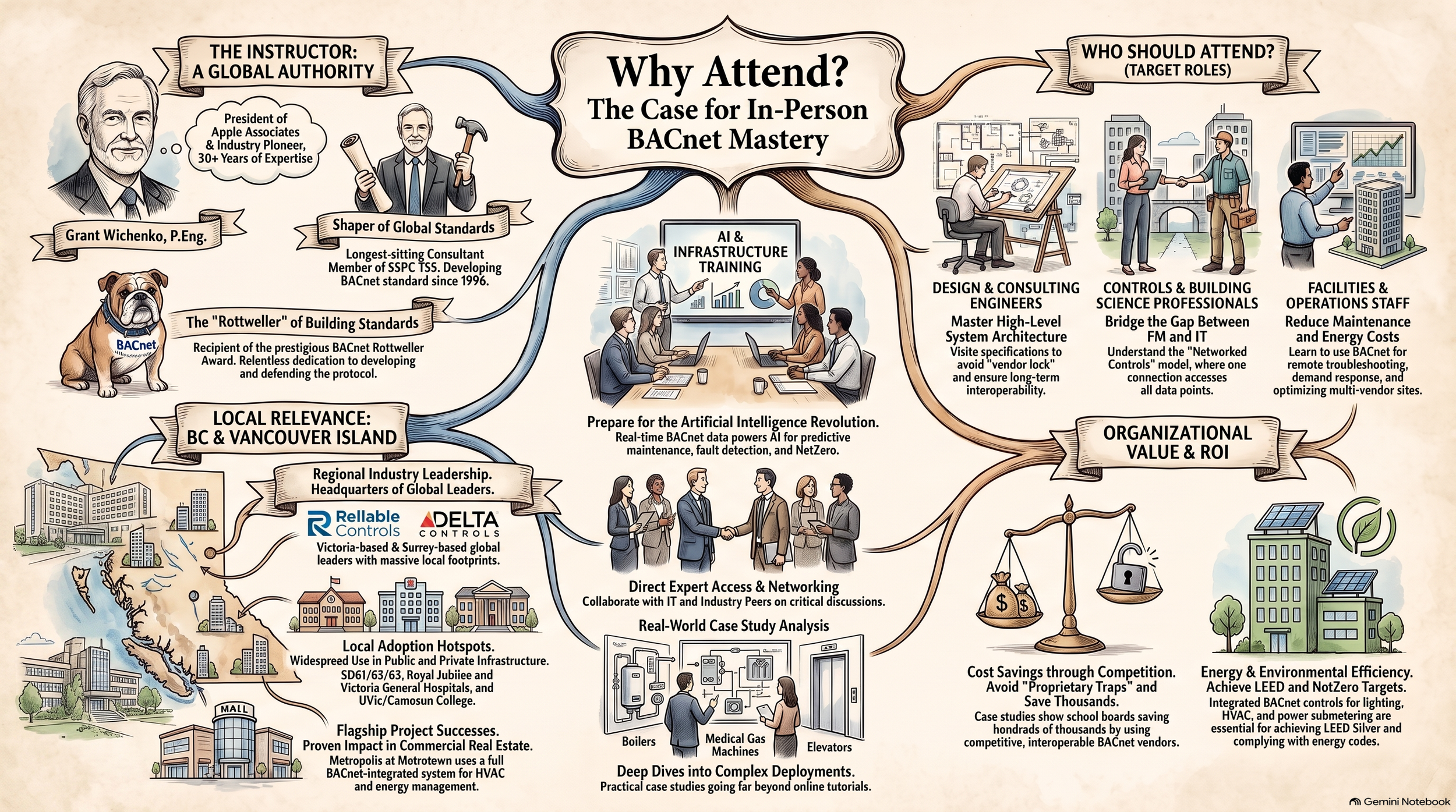
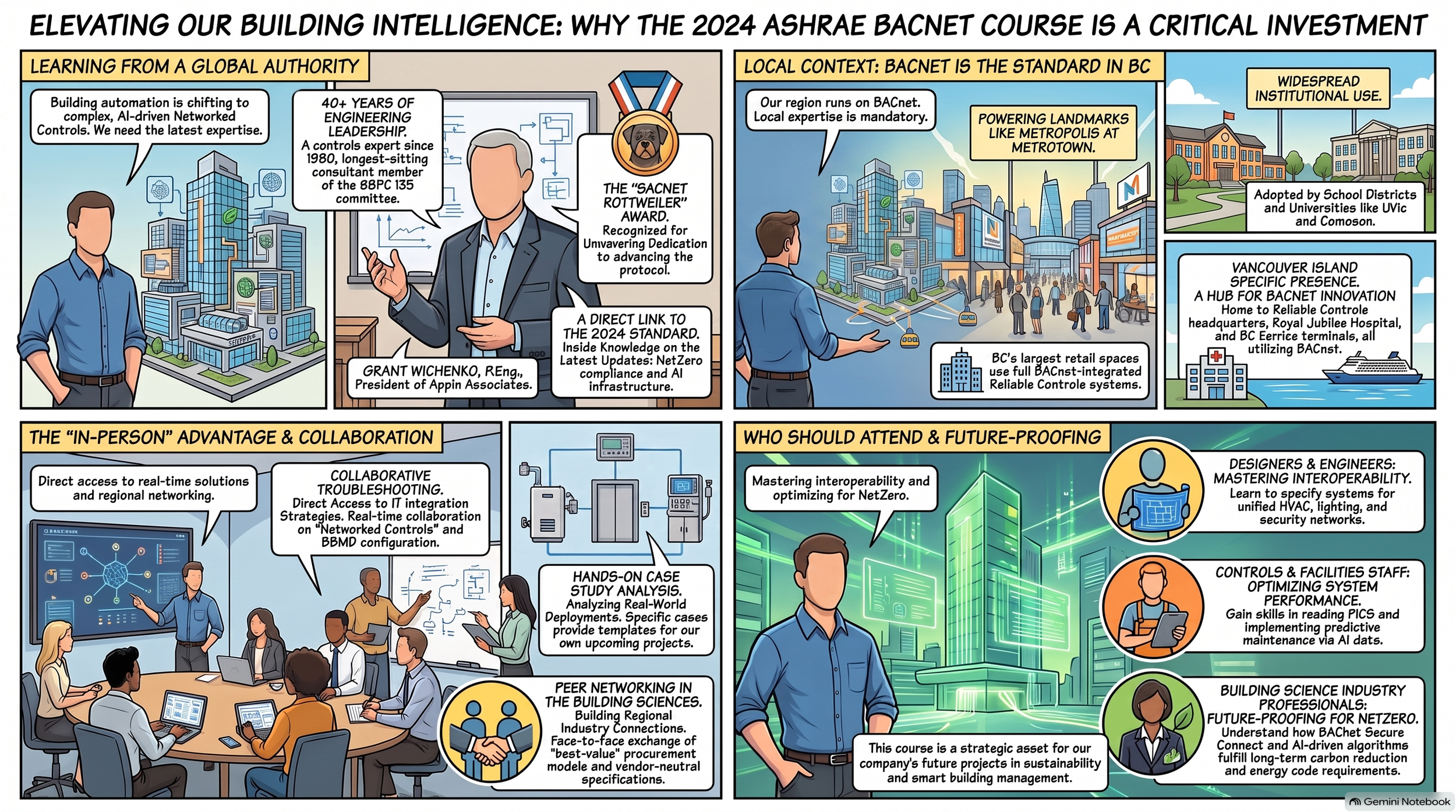

This course, based on the 2024 version of the BACnet Standard, helps attendees understand the essential elements required to successfully plan for BACnet® and tackle complex issues for achieving interoperability across a broad range of building systems, including HVAC, electrical, plumbing, elevators, fire alarm, security systems, and lighting.
In the first half, students learn the "language" of BACnet: key terms, how to read and interpret a Protocol Implementation Conformance Statement (PICS). The course covers BACnet/IP and BACnet MS/TP as well as new advancements such as BACnet/SC (Secure Connect) and BACnet/WS (Web Services). The integration of artificial intelligence is introduced, showing how AI-driven algorithms can leverage BACnet data for standard and advanced alarms and events. BACnet is the infrastructure that would allow for implementing fault detection, predictive maintenance, and optimization of system performance in an open and interoperable manner. Implementing these strategies is covered in ASHRAE’s SGPC 13 Guideline for Specifying Building Automation Systems.
The second half presents practical case studies on deploying BACnet in various equipment, including boilers, automatic transfer switches, elevators, and medical gas machines. Guidance is provided on collaborating with IT departments for device network integration, BBMD configuration, and device/object naming conventions. The course also addresses how BACnet’s rich data can support AI models for continuous building commissioning and long-term compliance with NetZero as well as the California Title 24 Standby Occupancy strategy for VAV systems.
BACnet is foundational for Smart Buildings—enabling mechanical, electrical, plumbing, solar, and other systems to communicate over a unified network, implement energy and utility strategies, and now, to power AI-driven building management. Real-time BACnet data can be harnessed by AI systems to maximize operational efficiency, optimize carbon reduction, and facilitate a building’s role in decarbonizing the grid and managing a carbon budget. The BACnet Energy Services Interface (ESI) introduced in the 2024 version of the Standard allows for building owners and operators to receive information, such as real time pricing from a utility. This data can be used to implement strategic demand response measures to minimize cost impacts in a manner that still meets the needs of the building occupants.
Instructor:
Grant N. Wichenko, P.Eng., Appin Associates
Biography
Grant Wichenko, P.Eng., Member ASHRAE
Grant Wichenko is a professional engineer with 30 years of experience in the controls business and is the president of Appin Associates. He has been on the ASHRAE SSPC 135 BACnet® committee since 1996. Wichenko is also a member of the Elevator Working Group and Chair of the Applications Profile Working Group. He has been a member of SGPC 13 BAS Specification committee since 1996.
Wichenko has taught a number of courses and given numerous presentations on BACnet® and networked controls to address the needs of owners, facility managers, and the various trades involved in the installation and implementation of automated control systems.
Ticket Pricing
Earlybird discount purchase by October 16
Event Tickets
Large Group Tickets $2,000 (good for your staff or your clients/suppliers)
8 ALI Tickets, Earlybird by October 16
7 ALI Tickets, Regular after October 17
Medium Group Tickets $1,200 (good for your staff or your clients/suppliers)
6 ALI Tickets, Earlybird by October 16
5 ALI Tickets, Regular after October 17
Small Group Tickets $800 (good for your staff or your clients/suppliers)
4 ALI Tickets, Earlybird by October 16
3 ALI Tickets, Regular after October 17
Individual Ticket
1 ALI Ticket $300 ASHRAE Member, Earlybird by October 16
1 ALI Ticket $400 Non-ASHRAE Member, Earlybird by October 16
1 ALI Ticket $350 Member, Regular after October 17
1 ALI Ticket $450 Non-ASHRAE Member, Regular after October 17
We need the name and email of all Attendees so we can send the ALI Course material to them via email before the course begins. If you do not have their name or email at this time please enter your name and email, we will add correct information later.
Sponsorship Opportunities
Prime Sponsor ($1,000, One Available)
Small tabletop location
2 ALI Tickets
Website recognition
5 Minute speaking opportunity during coffee break
Loyal Sponsor ($500, Two Available):
1 ALI Ticket
Website recognition
Thanks to Sponsors
Prime Sponsors
Loyal Sponsors


Who should attend
Architects — Especially those involved in commercial, institutional, or energy‑efficient building design.
Automation technicians — BAS installers, integrators, and field techs working with BACnet or similar protocols.
Building owners — Owners of commercial, industrial, or multi‑unit residential properties.
Building operators — Day‑to‑day facility operators who manage HVAC, lighting, and controls.
Consulting engineers — Mechanical, electrical, and energy engineers involved in building systems.
Controls contractors — BACnet integrators, commissioning agents, and automation specialists.
Energy managers — Professionals responsible for energy optimization and sustainability planning.
Facility managers — Leaders overseeing building operations, maintenance, and capital planning.
Government officials — Municipal, provincial, or federal staff involved in building codes or sustainability.
HVAC contractors — Mechanical contractors who install or maintain HVAC systems.
Mechanical engineers — Designers of HVAC, hydronics, ventilation, and building systems.
Policy makers — Those shaping building standards, energy policy, or climate initiatives.
Project managers — PMs overseeing construction, retrofits, or building automation upgrades.
Property managers — Managers of commercial, retail, or residential buildings.
Software developers — Especially those working on BAS, IoT, or smart‑building applications.
Students — Engineering, architecture, or building‑tech students seeking industry exposure.
Sustainability consultants — Specialists in green building, carbon reduction, and energy performance.
System integrators — Professionals who integrate HVAC, lighting, security, and BAS systems.
Utility representatives — Staff from BC Hydro or municipal utilities involved in energy programs.
Why you should Attend
Professional development — Strengthens leadership, communication, and strategic decision‑making skills that directly improve project outcomes.
Improved technical competency — Deepens understanding of BACnet, building automation, and emerging standards that affect our current and future systems.
Better project execution — Helps streamline coordination with contractors, engineers, and facility teams, reducing delays and miscommunication.
Networking with industry leaders — Builds relationships with BC and national professionals, opening doors for collaboration, vendor support, and future opportunities.
Alignment with industry standards — Ensures our team stays aligned with ASHRAE best practices, new protocols, and regulatory trends.
Enhanced problem‑solving — Provides tools and frameworks for tackling complex building automation challenges more efficiently.
Bringing back knowledge — You can share insights, notes, and actionable improvements with the team, multiplying the value of your attendance.
Supports organizational goals — Helps advance energy efficiency, modernization, and reliability initiatives that leadership already prioritizes.
Cost‑effective investment — One attendee can bring back training, templates, and best practices that benefit the entire department.
Future‑proofing skills — Prepares you for upcoming changes in BAS, cybersecurity, BACnet/SC, and smart‑building technologies.
